Published by KAY ROWAN, March 2025
This story is a work of fiction. The names, characters and events are the products of the author’s imagination or are used fictitiously. Any similarities to real people, places, or events are entirely coincidental.
SOLACE Copyright © 2025 Kay Rowan
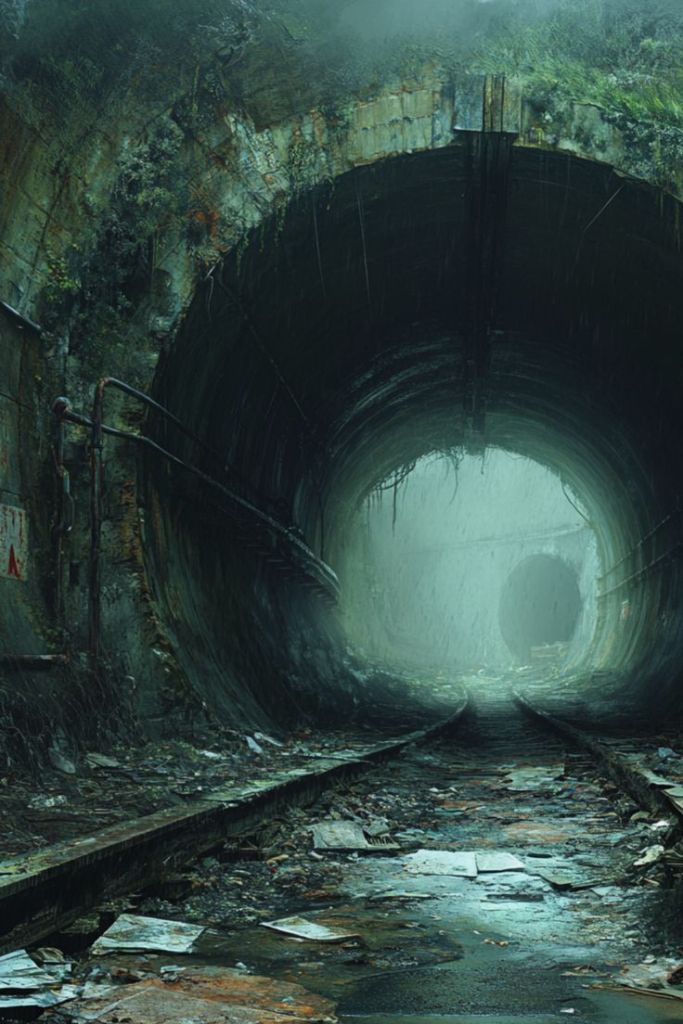
Sitting in this tunnel really did feel like being inside the belly of a snake. Somewhere, far above her head, almost lost to the shadows, the wide, curved beams of the roof were eerily reminiscent of ribs. Here and there, fine cracks broke across the stone as the vines and weeds slowly pushed the bricks apart, promising one day to bring the whole thing crumbling down.
Margo turned over uncomfortably and looked back at the wall, plastered with rainwater and newspaper clippings displaying the faces of missing people. She didn’t recognise a single one of them. Evidently, nobody had been in this tunnel for a very long time. The newspaper clippings were made almost indecipherable with age, and the rails she was sleeping on were rust-eaten and weatherworn. If she closed her eyes, she could almost pretend the rhythmic beating of the rain outside was an approaching train. But no trains were running anymore; she would have found somewhere else to hide out if they had been. She couldn’t even remember the last time she’d been on a train.
Someone had scrawled the words ‘ANGELO’S SURVIVED’ in blue paint on the wall. The last few letters of SURVIVED had been almost completely chipped away. She briefly wondered what had happened to the Angelo’s: maybe they had been some wandering gang, or a family passing through who had also been looking for Solace. But why advertise to the universe that you had survived? It didn’t make any sense – death was already outside, why would you dare him to knock at your door?
‘Hubris’.
She remembered the lecture hall. It had been an intimidating, cavernous space, and the board of directors had apparently been very proud of it: ‘a testament to the reinvention of brutalism by modern day architects’, apparently. What that actually seemed to mean was painting everything white and replacing the odd wall with glass. It had apparently been specially designed to ensure that every student, no matter where they were sitting, would be able to hear the lecturer perfectly. Harry had told her that it had all been done for some incredibly complicated tax reason, that it existed purely as a way for the University to prove they were investing in student wellbeing, giving them some kind of ‘return’ for their insanely high tuition fees. The publicity was also a good way of disguising the fact that they had been forced to reduce the green space on campus by 15%, just to make the building happen.
The lecture that day had overrun. Normally she would sit outside in the corridor until he was finished, but for some reason, she had decided to sneak in and sit at the back. A few students had given her a single, disinterested glance before going back to whispering with each other. She had remembered being so angry about that at the time. ‘Granted they are being messed around by the University’, she had said to Harry on their drive home that night, ‘but surely there were better forms of protest than just passing notes!’
‘The information is right in front of their faces’, he had replied in his typical, resigned way. ‘If they want to look away from it, that’s on them’.
The likelihood was most of them probably hadn’t even lived long enough to graduate.
‘Hubris’, Harry had said, the little microphone he’d been using squeaking slightly in protest. ‘We have our friends in Ancient Greece to thank for that concept. Originally it meant to degrade, or to commit an act of violence. Hamartia (he’d scrawled ἁμαρτία on the whiteboard behind him in his distinctive, indecipherable handwriting) translates as ‘to err’. It was used for those mortals who tried to challenge the Gods, like Arachne playing at weaving with the Goddess Athena. Hubris would be used in its place by some poets later on, conflating the meanings of the two. So to indulge in Hubris is to believe, mistakenly, that you are greater than The Gods themselves: the height of ego, an act of sheer, spiritual violence.’
“It seems The Gods came up with a more interesting punishment than turning us into spiders, darling,” said Margo into the damp air.
No one replied.
The storm was relentless. It had become the kind of rain that felt like a wall being repeatedly slammed into you. A little ways ahead, the tunnel opened up into a watercolour-smudged landscape of browns and greys. She had circled around the city centre on her way, but kept to the abandoned train track so she didn’t lose her sense of direction entirely. Even though the gangs had mostly moved on or died out by now, there was something uncomfortable about walking through cities, past the vacant shopping centres and the forlorn skeletons of old playgrounds. She only ever risked it when she had to for supplies.
A few houses remained standing where she was now, their walls cracked in like egg shells, and trees lined the side of the track as it curled gently out of sight. Looking back down the way she had come, the tracks were more irregular, nature slowly pushing in to reclaim its lost territory, wrenching apart the metal supports as if they were made of paper. The station had been about half a mile back, but she’d decided against sleeping there. Even though it was unlikely anyone would find her, caution, once learned, was a habit that died reluctantly.
‘I can only hope that goes for me too’, she thought, giving up on sleep and standing. She stretched until feeling returned in a blur of aches across her muscles. Even through the extra thick padding of the bedroll, the joints of the track had found their way into her spine. She adjusted the fit of her armour beneath her clothes and sighed. The straps had been perfectly tailored to her shape, the edges smoothed over by a guy who she had done some translating work for back when everything had first gone wrong, but the metal felt frostbite-cold at this time of year. She didn’t take it off though, not for the depths of winter or the heights of summer; not when a single cut could be the end of everything. ‘If you were going to get injured’, the saying had gone, ‘the bigger the better’. Even a small scrape might have you slowly bleeding out over a week. At least a more dramatic injury meant it would be over quickly.
She shouldn’t have survived all this. She’d had this argument with herself a thousand times already, and had lost it every time. Harry had been the one doing those ridiculous hikes across generic parts of Europe, all for the photo opportunity of standing on a mountain looking pleased with himself. She had admired him, of course, but hadn’t really understood the appeal of sleeping under a rather tragic piece of tarpaulin when, as she had explained to him a dozen times, we had done such a good job with inventing beds.
‘I used to wear dresses’, she thought to herself, as she watched a single bead of rain water crawl down the length of a rusty pipe above her, forming a perfect little gem on its edge. ‘I wouldn’t even know what to do with a dress now. None of them would have even made good tinder. Maybe, when I get to Solace, I can find Arachne and ask her to make me one…’.
The gem of water landed, squarely, on her face, snapping her scrambled thoughts back into order again.
Moments like that were getting all too common now: strange, circular thoughts that never really ended up at the destination she had been heading for. Her editor had once told her that starting a sentence was like firing an arrow, and it always had to hit a bullseye, even if it wasn’t the one the reader had been expecting. She salvaged her gloves from her pack. That was nice – just a mundane little memory. Happy memories were sad because they were over, and sad memories were sad because they were, well, sad – but a mundane memory could keep you going for hours. Sliding them on, she set up a small gas burner on a dry ledge in the tunnel wall and began to boil some coffee. She had miraculously found an unopened tin of it a little while ago, and after letting a curious bird drink some of it to make sure it wasn’t poisoned, had carefully rationed it for herself over the last week.
‘Coffee’.
She had used to go into coffee shops to write. When they had first moved into their little overpriced apartment, Harry had insisted they set aside corner of it for her to write in. It had been one of those sweet, honeymoon-phase promises he had made to her, back when he had done that kind of thing. He had even bought the desk she had asked for, and set it up with everything a writer could want, which mostly consisted of a lamp, a soft toy armadillo she had owned since she had been four, and close proximity to a means of making coffee. But even so, it had started to feel too claustrophobic after a while, writing surrounded by all his things. Working in a coffee shop made it easier to look like she was doing something profound, and disguise what she was actually doing, which mostly consisted of writing one unpublishable paragraph after another, whilst simultaneously ignoring the emails from her agent, the ones that she could only handle with a glass of wine and a sleeping pill…or two.
The barista had insisted on bringing her coffee to the table that day, which was new. As a writer, Margo had known probably better than most people how much of a stereotype falling in love with your barista was. It was the kind of thing that solely existed in those yearning, Hollywood lesbian romances she had pretended for far too long hadn’t resonated with her. It was almost pathetic how she had subconsciously decided that this was her place to go to for inspiration, long before she had realised that this was more for the crush than for the ambience.
Imogen. It had been emblazoned in a particularly garish font to a label she had apparently been forced to wear by head office. ‘To remind people we are actually human beings’, Imogen had said to her. She had brushed Margo’s hand as she had placed the coffee down on the table, and Margo could have kicked herself at the sound she’d found herself involuntarily making. It had only been after a few minutes, when she had successfully regained her composure, that she had noticed the scrap of paper with a phone number slipped under her cup.
One night as they had laid in bed together, Imogen had asked her the question every writer dreaded,
‘What’s your book about?’
Margo had sighed and nestled deeper into the crook of Imogen’s arm.
‘Nothing yet.’
‘Oh no, don’t avoid the question! How can you be writing for months and not know what the book’s about?’
‘Because that isn’t up to me,’ Margo had said sleepily. ‘That’s for reviewers and students to decide. I am just the one who makes it all up.’
‘Then how do you know what to write about?’
‘I guess I don’t,’ Margo had herself say. ‘I just write and kind of hope for the best. Maybe on some deeper level there’s this meaning I am chasing, you know, this unspoken desire to be some great novelist that will be revered for years to come, but now I don’t care anymore. I don’t need to be remembered. I just write because it’s all I know how to do.’
‘I think it would be nice to be remembered.’
‘Depends what for,’ Margo had chided, kissing her cheek. ‘It can destroy you, wanting that.’
‘I think it should be a love story,’ Imogen had replied decisively, ‘about a woman who falls in love with a barista, who teaches her that she is worth being remembered. Not for being famous or anything. Just for being Margo’.
She had laughed at that.
Margo stared out at the rain. It was going to be at least a few days’ march to Solace, but she couldn’t leave quite yet. She had no idea what Harry would have suggested. He probably would have told her that she was being ridiculous. Idealistic. That she was committing some act of spiritual violence against The Gods, but it wasn’t as if there was much left to take from her at this point. Imogen would probably have just kissed her, and it would have been utterly wonderful, as well as profoundly unhelpful.
It only took her only a few minutes to find what she was looking for. The tin of paint that the Angelo’s had used had been left open, and had long since curdled into uselessness, but there were still a few unopened ones next to it. She grabbed her blade from her bag and, as carefully as she could, worked to prise the lid off. She felt the bite of the blade against her skin as it skipped across the wet surface, felt the bright blossom of pain which followed, but she didn’t stop. When she got to Solace, they would be able to look after her, she was sure of it. She stuck her finger in her mouth, tasting the sting of iron and rainwater, and kept working at the lid until it gave way with a satisfying ‘pop’.
She thought for a second, and then using the handle of her blade as a brush, wrote next to the message from the Angelo’s:
MARGO WAS HERE. SURVIVED AND SEEKING SOLACE.
She stepped back and took a second to admire her work. Then, without another glance, she threw her bag onto her back and stepped out into the storm. The tunnel was once again empty, with only the rain left to keep the silence company.
 KAY ROWAN / GHOSTGIRL